🙋 Student Q&A (Lecture 5)
Click here to learn about timestamps and my process for answering questions. Section agendas can be found here. Email office hour questions to rob.mgmte2000@gmail.com. PS1Q2=“Question 2 of Problem Set 1”

📅 Questions covered Saturday, Feb 28
Section titled “📅 Questions covered , Feb 28”🕣 3:28pm
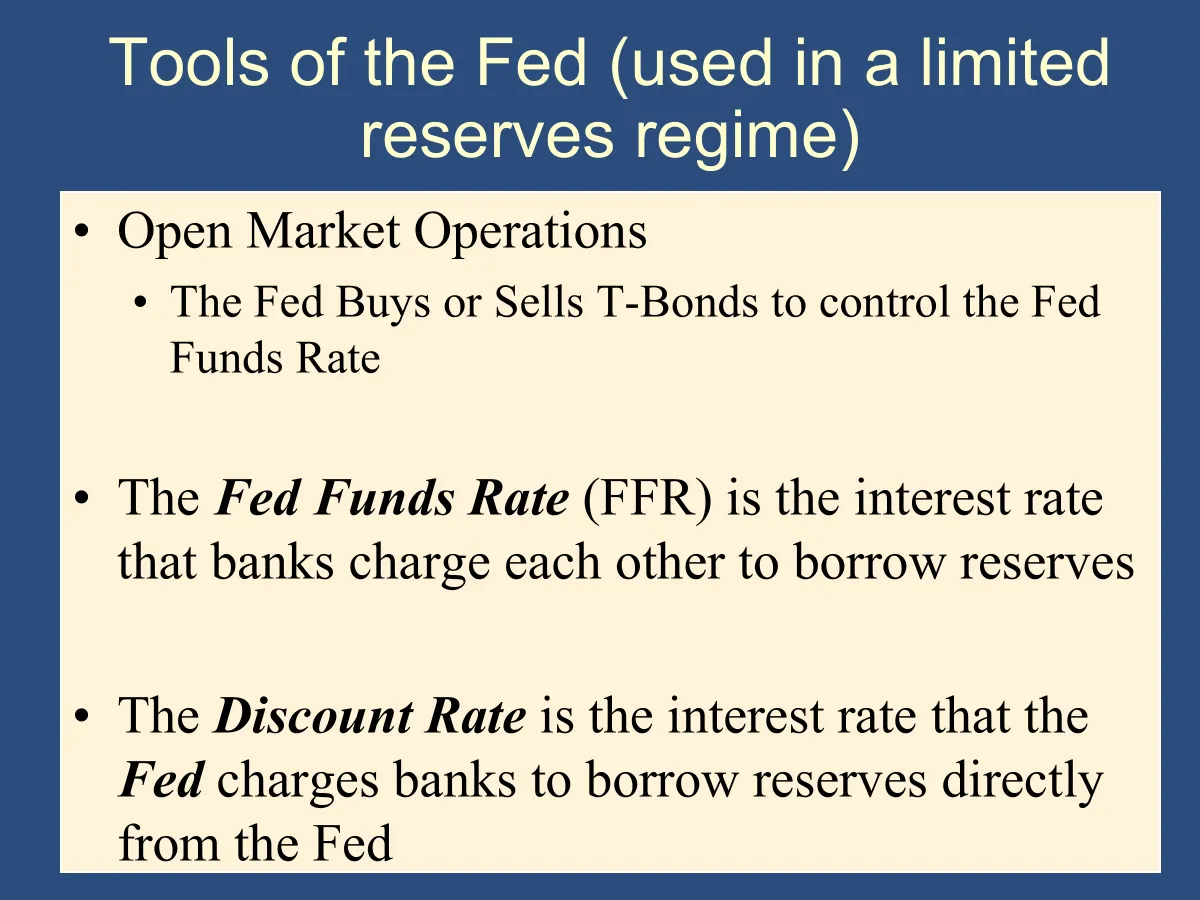
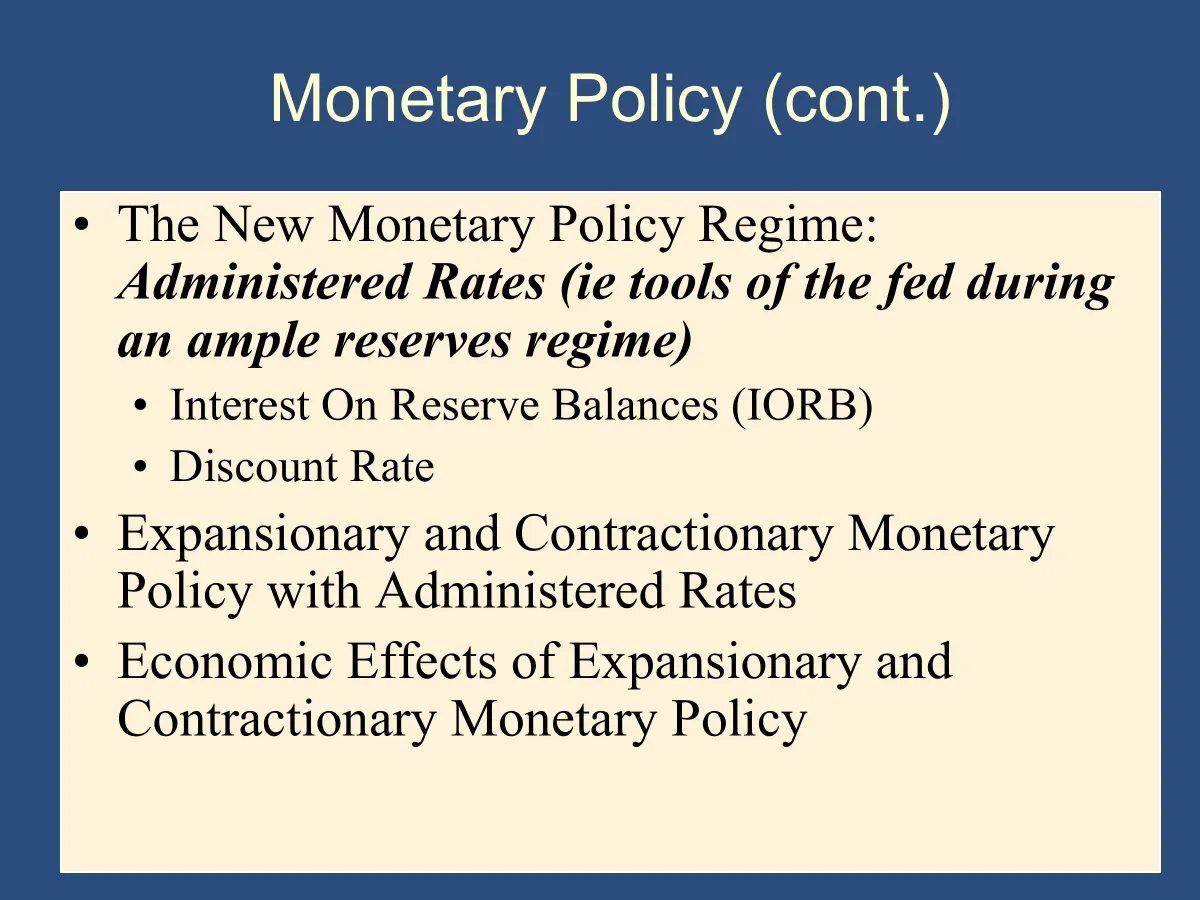
❔ I think I see two different slides for tools of the Fed.
✔
🕣 3:32pm
❔ Explain the different fed tool interest rates.
✔
- The Fed funds rate (FFR) is the rate at which banks lend money to each other.
- The Interest on reserve balances (IORB) rate is the interest rate that the Fed pays to banks when they have deposits at the Fed.
- The Discount Rate is the rate that the Fed will lend money to banks at if they are in good financial shape.
In both the Ample and Limited Reserves Regime, the FOMC does monetary policy by announcing a target Fed Funds Rate.
-
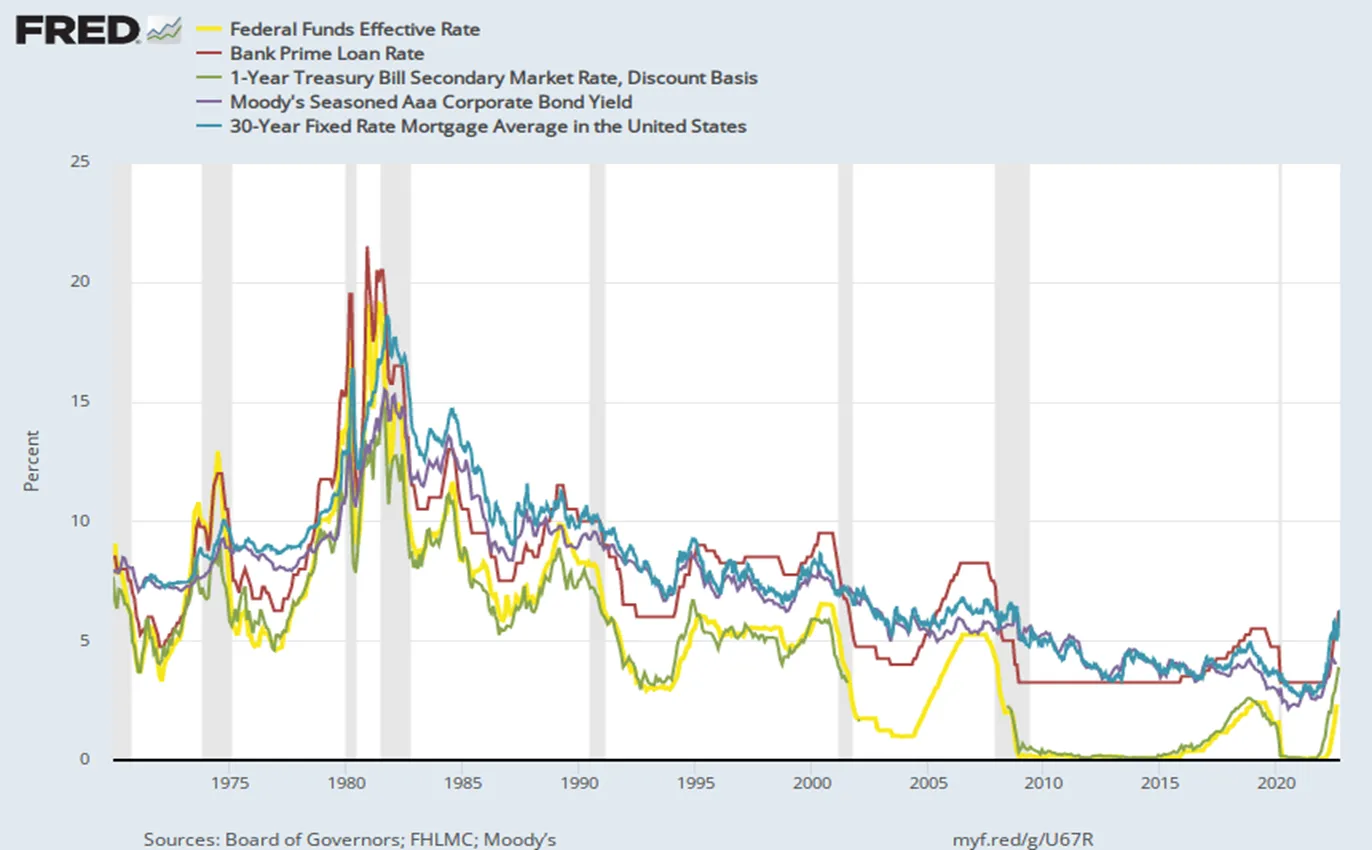
The Fed funds rate is the rate that banks use to get more money in order to lend to you. Therefore, by changing the Fed funds rate, the Fed can change the rate at which banks lend money to you. We think of it as the foundational interest rate in the US.
-
However, banks can’t directly control the Fed funds rate, because the Fed doesn’t have the legal power to do that. The Fed funds rate is the rate charged by two free banks, and they can charge whatever rate they want, so the Fed has to use specific tools to try to get the Fed funds rate within its target.
-
During a Limited Reserves Regime, it tries to keep the actual Fed funds rate within its target by doing open market operations.
-
Within an Ample Reserves Regime, it tries to keep the Fed funds rate within its target by changing IORB and the discount rate.
-
Quantitative easing is the fire extinguisher behind glass “only use this in case of emergencies.” You use it when the Fed Funds rate is already at zero and you need to further stimulate the economy.
“We think of FFR as the foundational interest rate in the US.”
🕣 4:28pm
❔ What are expectations for diagrams?
✔ We are definitely flexible about diagrams. The most important thing about your diagram is that it is understandable and that it is clear to the grader that you’ve done the work that you need to do. As long as you’re meeting that, you can just take a screenshot and paste it into the box for the problem.
🕣 4:31pm
❔ I completed the problem set for this week and noted it had a number of graphs requested. I uploaded graphs by first hand drawing them, taking a picture with my phone, then uploading them on my Mac.
Was this the correct format or is there an easier, faster way? Will we need to do this for the tests? I’m nervous not knowing a different way with Proctorio and don’t want to cause any issues with using phone/copy/pasting. I know Proctorio turns off some of those features.
✔ That was just fine for the homework.
I will make a quiz that you can practice image uploads with while running Proctorio. Anything that you can do with this quiz can also be done during the exam.
🕣 4:34pm
❔ On Question 8 (or 4d), there’s this phrase in the hint: “To explain
your result, think about what a steeper or flatter money demand curve
implies about money demand.” But, the main question asks “Will the
interest rate change more if the money demand curve is steeper or
flatter?
Do I need to go on a deep dive about the implications of more or less
elastic money demand in an economy, or can I just answer the question
stated?
✔ It’s tough to know what any given individual means by a deep dive or just answering the question stated. You definitely want to answer the question that is stated. I would follow the hint. Watch the video for a little bit more information on how to handle this.
📅 Questions covered Tuesday, Mar 3
Section titled “📅 Questions covered , Mar 3”🕣 7:50pm
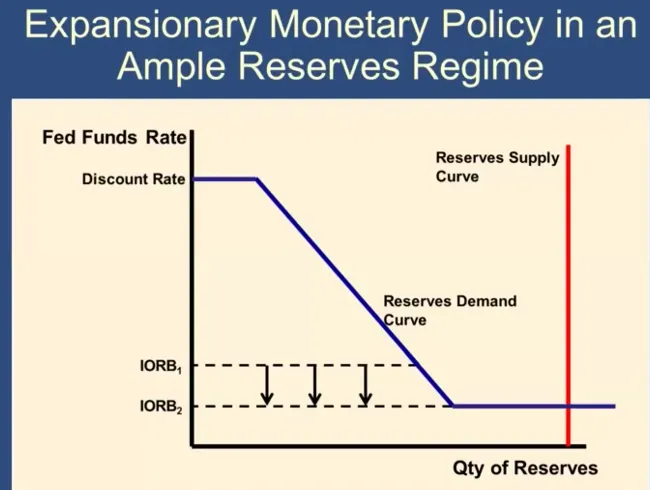
❔ On the slide below for L5, Professor Watson briefly touches upon why the Feds will not opt to lower the discount rate in this expansionary policy. I want to ensure my understanding on this is correct -Is it because the FFR is always equal to the IORB in the ample reserve regime and lowering in case of expansionary ( incresing in case of contractionay) is the primary mechanism the Feds will always use to impact FFR and stimulate the economy?
🕣 8:36
❔ How to ask a good question
✔ A good question is either “interpretation” or “conceptual” conceptual = ask me about finance. interpretation = help you interpret the question.
🕣 9:21pm
❔ Another question for midterm, since I am starting to prep for it— For those of us who use a blank Excel spreadsheets to lay out our processes, variables and calculations, it is really throwing me off that copy/paste will be turned off in Proctorio for the exam. With that being said, say- for instance- I have laid out a set of cash flows over a 5 year period, along with their PV calculations, the NPV, IRR, etc. Can I screen shot that set of cash flows I have laid out in Excel, save/download the screenshot as a photo and upload it into Proctorio to help support my answer pm a problem? It just seems really time-consuming to have to duplicate this information in Proctorio if I have already laid everything out in another program from scratch and just want to show my work.
✔
🕣
❔ What is a recession?
✔ A recession is a relatively prolonged period of underperformance in the economy. You don’t really need to know more about it for this class. We talk about it in Essentials of Economics, but yeah, it just is the nature of the economy where sometimes it does well and sometimes it does poorly, and there’s lots of layoffs. Often, when it does poorly (i.e., when there is a recession), it’s because people aren’t buying enough stuff or the financial system is weak. Sometimes a recession will happen because oil prices rise. Usually we have a recession every couple of years, and usually they last for like six to 12 months, but sometimes they’ll last for a couple of years.
🕣
❔ Reserves
✔ I am confused about the language of Reserves, Interest on Reserve Balances, Required Reserves, Reserve Requirement, and Required Reserves Ratio (R). It feels like we are using them interchangeably but there may be some nuanced differences.
For the purpose of doing calculations and using our formulas, will you please explain the exact definition of each and the differences between each and how to know with certainty which is being referred to in our formulas and Problem Sets?
Basically when I read the Problem Sets, I am having doubts about what is being asked of me and what is being represented in the formulas!
- Reserves - Vault cash and deposits at the Fed that a bank can use if people start withdrawing their money
- Interest on Reserve Balances - an interest rate that the Fed will pay to banks that have deposited money at the Federal Reserve
- Required Reserves - formerly, banks were required to hold a certain amount of reserves legally. These were known as required reserves.
- Required Reserve Ratio (R) - the amount of required reserves that a bank had to hold was usually 10% of their deposits. This 10% is the required reserve ratio.
Suppose a bank has $100,000,000 of deposits and the required reserve ratio is 10%. In this case, the amount of reserves the bank is required to hold is $10,000,000, and the required reserve ratio is 10%.
- Required Reserves
- Excess Reserves
- Total Reserves
What is the total reserves held by
🕣
❔ Timing on the exam? Extra 10 minutes?
✔
🕣
❔ How do we calculate the dollars of bonds a central bank should buy or sell, based on how much they want to want to lower the money stock? What formula do we use? Can you show us a few examples?
Did we learn how to do that in the lecture? If so can you please remind me around what slides?
✔
🕣
❔ For Lecture 5 slide 24 with the Reserve Supply and Demand curve, what is the difference from Lecture 4, Slide 56 Money Market Curve? How are they related (if they even are)?
✔
🕣
❔ equilibrium points - the point where MS, MD, and interest rate meet: In many graphs, it goes up seemingly forever. Why?
And vertical money supply in general.
Both Feb 17 and 24th lectures - Money and Reserves.
✔
🕣
❔ Nominal interest rate vs real vs FFR.
In limited reserves, which is i?
✔
🕣
❔ for Q4 3. do we just list the causal chain of the transmission mechanism or should we go into detail into each list item/components of aggregate demand?
Q6 4b. I’m a little confused on this question using a diagram, is the result of total reserves will be included in drawing the diagram?
Q8 4d. are the flat and steep lines straight lines? or is the steep line specifically bowed? (I just want to confirm on the meaning of steep line/steepness)
✔
🕣
❔ For Lecture 5 slide 24 with the Reserve Supply and Demand curve, what is the difference from Lecture 4, Slide 56 Money Market Curve? How are they related (if they even are)?
✔
🕣
❔ I completed the problem set for this week and noted it had a number of graphs requested. I uploaded graphs by first hand drawing them, taking a picture with my phone, then uploading them on my Mac.
Was this the correct format or is there an easier, faster way? Will we need to do this for the tests? I’m nervous not knowing a different way with Proctorio and don’t want to cause any issues with using phone/copy/pasting. I know Proctorio turns off some of those features.
✔
🕣
❔ I hope this is an OK question to ask about the problem set, as it’s a
”clarifying the question” question rather than a “how do I do this”
question.
On Question 8 (or 4d), there’s this phrase in the hint: “To explain
your result, think about what a steeper or flatter money demand curve
implies about money demand.” But, the main question asks “Will the
interest rate change more if the money demand curve is steeper or
flatter?
Do I need to go on a deep dive about the implications of more or less
elastic money demand in an economy, or can I just answer the question
stated?
✔
Feedback? Email rob.mgmte2000@gmail.com 📧. Be sure to mention the page you are responding to.