🔎 Algebra Review
General principle:
- If you’ve got something on one side, you can move it to the other side, but with the opposite operation.
- Look for this principle in the key operations below. Then just remember the principle.
Key Operations:
Section titled “Key Operations:”Add/Subtract x from both sides
Section titled “Add/Subtract x from both sides”You can add or subtract x from both sides to move a number over to the other side of an equation.
If you start with
You can add a 1 to both sides:
You get
You can divide both sides by the same number
Section titled “You can divide both sides by the same number”You can divide both sides by x to move a number over to the other side of an equation.
If you start with
You can divide both sides by 4:
You get
How to get rid of a pesky exponent
Section titled “How to get rid of a pesky exponent”To get rid of a pesky exponent, you can move it to the other side as a fraction.
For example,
becomes
✏️ Suppose you have a 10 year zero coupon bond with a face value of $1000 that is currently selling for $500. What is its YTM?
✔ When he says that something is “selling for” $500, he means that that is its price, so PB = $500, F=$1000, T=10.
We just write down the bond pricing formula:
The first step that we do is the “switcheroo:”
Recopying, and simplifying we get:
Now we move the “10th power” exponent over to the other side as a “one 10th power:”
You can enter this in to a spreadsheet or Google as 2^(1/10). Do it exactly like that. don’t omit parentheses. 🙋♀️”PEMDAS is your friend! 😄”
Therefore, i=7.177%.
To understand the switch
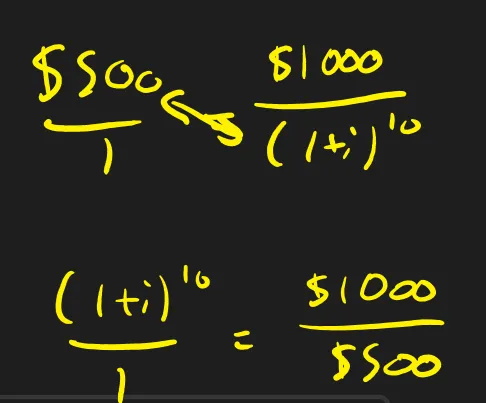
What you are really doing
Section titled “What you are really doing”You can take the same exponent of both sides to get rid of an exponent. For example if one side of an equation is to the tenth power, you can take the th power of both sides. This will give you what you want.
If you start with
You can take the “one tenth” power of both sides:
You get
Plug and Chug
Section titled “Plug and Chug”If you stuck, you can often solve the problem using “plug and chug.” With some practice, you’ll find it easy!
- Identify the number you need and numbers you know.
- Need to know:
- Already know: Do you know an equation that connects the number you need to the numbers you know?
- Plug 🔌 the numbers you know into the equation.
- Algebraically solve for the needed quantity (“chug” 🚂). If you like, you can check ✔ your algebra by plugging your answers back into the original equation.
- Think over 🧠 your result. Does it make sense based on what you learned in class?
I will often summarize these four steps with the following template:
Plug and chug:
1. Equation →
2. Plug 🔌 →
3. Solve 🚂 →
4. 🧠 →
Notes:
- Math fact: If you know all of the numbers in a formula except one, you can generally use algebra to find the last number.
- This method is just how you solved basic word problems in Algebra class. We realize that it may have been years or even decades since you took algebra, so we’re trying to make it as “step by step” as possible!
✏️ Suppose that a given company has an ROA of 1.5% and Assets of $1 billion. What is the firm’s profit after taxes?
✔ Solving this is easy. You just find an equation, plug numbers into it and do very basic algebra.
Plug and chug:
1. Equation → We’ll use the definition of ROA, ’
ROA = ProfitAfterTaxes/Asset
2. Plug 🔌 →
1.5% = ProfitAfterTaxes/$1B
3. Solve 🚂 →
1.5%×$1B = ProfitAfterTaxes
ProfitAfterTaxes = 1.5%×$1B = $15M
4. 🧠 → Let’s check our work by plugging back into the formula.
ROA = ProfitAfterTaxes/Asset
ROA = $15M/$1B = .015 = 1.5%
✏️ Suppose that total deposits in the economy increase by $5B, but the money supply only increases by $4.5B. What happened to Cash in the hands of the public?
✔
Plug and chug:
1. Equation →
ΔMS=ΔDeposits+ΔCash Held by Public
2. Plug 🔌 →
$4.5B=$5B+ΔCash Held by Public
3. Solve 🚂 →
$4.5B-$5B=ΔCash Held by Public
ΔCash Held by Public = $4.5B-$5B = -$.5B
4. 🧠 → You can plug the numbers back in to check.
✏️ Suppose that rf = 5%, the market risk premium, Erm - rf, is 6%, and for a given stock its expected return, Ers, is 9%. What is β?
✔
Plug and chug:
1. Equation →
E(rS)=rF+β[E(rM)-rF]
2. Plug 🔌 →
9%=5%+β[6%]
3. Solve 🚂 →
9%-5%=β[6%]
4%=β[6%]
4%\div6%=β
β = 4/6 = .66
4. 🧠 →
Math worksheet
Section titled “Math worksheet”Feedback? Email rob.mgmte2000@gmail.com 📧. Be sure to mention the page you are responding to.