❔ Balance Sheet and Reserves questions
Bruce sometimes gives you problems where you must “fill in the blanks” in a balance sheet. Here are some problems to build up skills with this.
In all of the following questions, you may assume that there are no other categories of assets or liabilities other than the ones listed on the Balance sheet (he often makes that assumption in problem set problem)
Helpful Equations
Section titled “Helpful Equations”There are very helpful formulas for this in the formula sheet. They can be found at robmunger.com/2000share
General Balance Sheet “Fill in the blanks” questions:
Section titled “General Balance Sheet “Fill in the blanks” questions:”The most foundational piece of information that you will use in a problem like this is the fact that the two sides of the balance sheet must balance ⚖️. In other words:
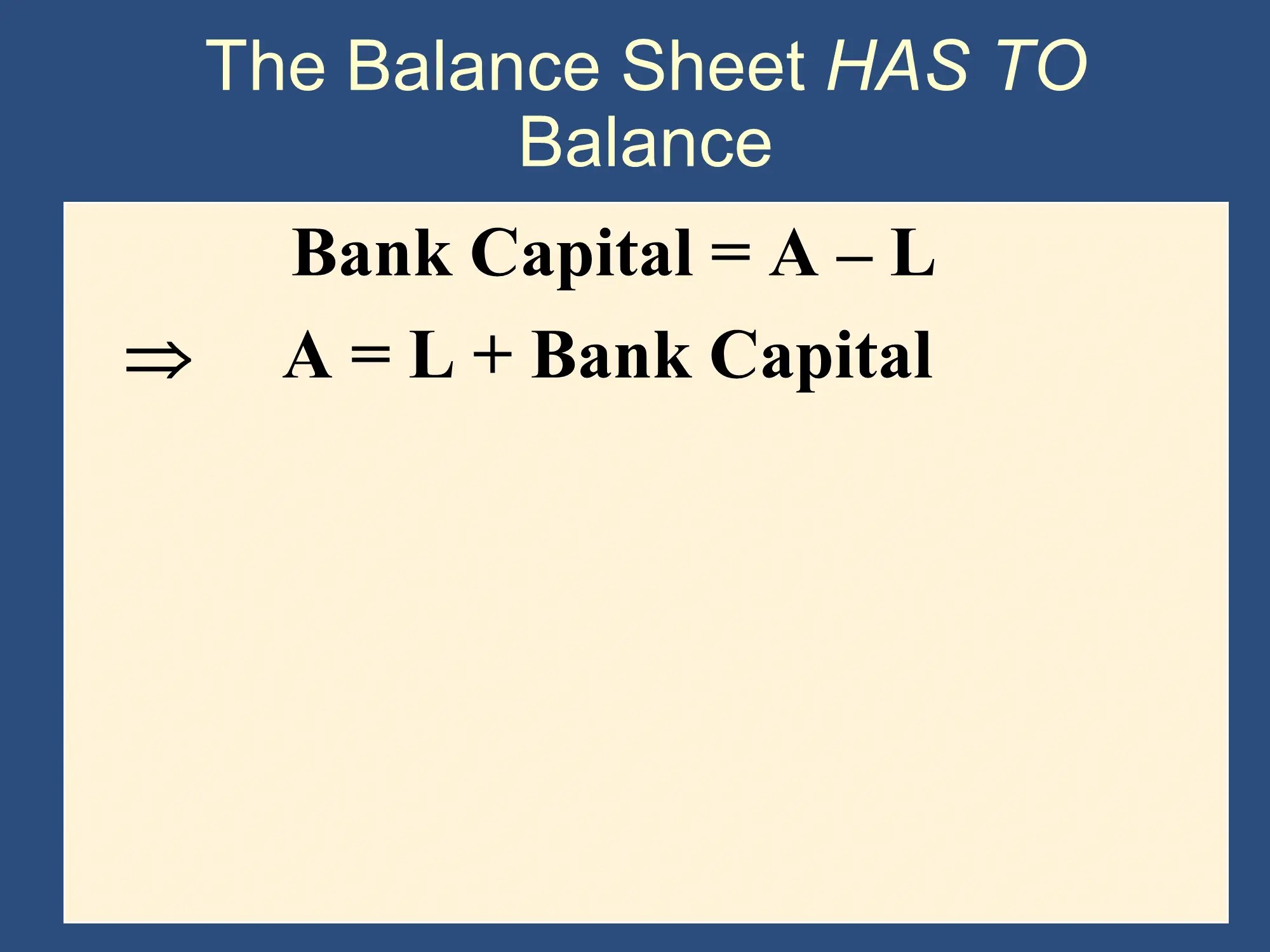
Also, these questions will use the fact that there are two types of assets that are considered to be “Reserves.” Specifically, only Vault Cash and Deposits at the Fed are considered to be Reserves. Mathematically, this means that
✏️ Calculate the amount of reserves and Deposits at the Fed held by this bank:
| Assets () | Liabilities () |
|---|---|
? Reserves | $5M Deposits |
| $0.5M BC |
| Assets | Liabilities + Bank Capital |
|---|---|
? Reserves$.1M Vault Cash$4.5M other assets | $5M Deposits |
| Bank Capital $0.5M | |
Total Assets = | Total Liabilities + BC = |
✔ Click here to view answer
The two sides of any Balance sheet must always “balance,” in that all of the numbers on the left (Assets) must “balance” with all of the numbers on the right (Liabilities + Bank Capital):
Assets=Liabilities+Bank Capital ⚖️
Adding up all of the Liabilities + BC, we get $5.5M. Therefore, there must also be $5.5M of Assets.
Because there are $4.5M of other assets, the total amount of reserves must be $1M.
We fill in the table above as follows:
| Assets | Liabilities + Bank Capital |
|---|---|
$1M Reserves $.1M Vault Cash$4.5M other assets | $5M Deposits |
| Bank Capital $0.5M | |
| Total Assets = $5.5M | Total Liabilites + BC = $5.5M |
From the equation list, we have used the equations in red on the right 👉
The following problem is similar to the problem above, but you solve it in the reverse order.
✏️ Fill in the question marks.
| Assets | Liabilities + Bank Capital |
|---|---|
$? M Reserves $.1M Vault Cash$4.5M other assets | $5M Deposits |
| Bank Capital $? M | |
| Total Assets = | Total Liabilities + BC = |
✔ Click here to view answer
As before, we know that Total Reserves= Vault Cash+Deposits at Fed. Therefore, Total Reserves = $2M.
Likewise, as before we know that the two sides of the balance sheet must balance: Assets=Liabilities+Bank Capital. Plugging our numbers in, we get:
$2M + $4.5M = $5M + BC
BC = $6.5M - $5M = $1.5M
We fill in the above table as follows:
| Assets | Liabilities + Bank Capital |
|---|---|
$2M Reserves $.1M Vault Cash$4.5M other assets | $5M Deposits |
| Bank Capital $1.5M | |
| Total Assets = $6.5M | Total Liabilities + BC =$6.5M |
Analyzing balance sheets when R and E are given
Section titled “Analyzing balance sheets when R and E are given”Sometimes, R and E are given and we need to use them to do a “fill in the blanks on a balance sheet” type of question.
Bruce gives you the following equations:
$Required Reserves = R × $Deposits
$Excess Reserves = E × $Deposits
If you add these two equations together, you get the following equation:
$Total Reserves = (R+E) × $Deposits
R+E is your total reserves, as a fraction of deposits. For example, if you have 6% of required reserves and 14% of excess reserves, then your total reserves, a fraction of deposits is 20%. If you have $200M of Deposits, you must have $40M of Reserves:
$Total Reserves = (R+E) × $Deposits = (6% + 14%) × $200M = $40M
✏️ The fed requires that banks hold 12% of their deposits as reserves and banks decide to hold excess reserves equal to 3% of their deposits.
| Assets | Liabilities |
|---|---|
? Total Reserves $.1M Vault Cash$4.5M other assets | $4M Deposits |
| Bank Capital ? |
Calculate each of the green question mark quantities.
✔ Click here to view answer
R=12% and E=3%, so R+E = 15%.
You are holding 15% of your deposits as reserves.
Therefore, $TotalReserves = 15% × $4M = $.6M
Therefore, Deposits at the Fed = $.6M - $.1M = $.5M
Bank Capital = $5.1M - $4M = $1.1M
| Assets 5.1M | Liabilities |
|---|---|
$.6M Total Reserves$.1M Vault Cash$4.5M other assets | $4M Deposits |
| Bank Capital $1.1M |
✏️ Continuing the previous problem, what is the dollar amount of required reserves and excess reserves that this bank has?
✔ Click here to view answer
To calculate the required and excess reserves, we use the formulas that Bruce gave us:
Bank capital is ALWAYS changing. Remember that Bank Capital is the Net Worth of a bank. Therefore, anything that is profitable increases bank capital. Anything that is unprofitable decreases bank capital.
How much bank capital?
Consider the following transactions occur. How will this affect the balance sheet?
Refer to “How is the balance sheet affected?” in the main notes for Bruce’s main lecture on Balance Sheets. The section summarizes the slides Bruce presented with titles that start with “Changes in the Balance Sheet.”
Calculating R or E from a balance sheet
Section titled “Calculating R or E from a balance sheet”Sometimes, instead of R and E being given, we need to find them by looking at a balance sheet.
To solve a question like this, start with the equation we used in the previous section:
Divide both sides by $Deposits and you get:
This equation is extremely helpful for questions like this. We can think of R+E as the total reserves that the bank is holding - they are just written as a fraction of deposit.
✏️ Suppose R=4%. What is E?
| Assets ($5.5M) | Liabilities ($5.5M) |
|---|---|
$? Reserves | $5M Deposits |
| $.5M BC |
✔ Click here to view answer
We want to use our new equation, but we can’t unless we know $TotalReserves. Therefore, we calculate $TotalReserves by adding VC + DaF.
We plug the numbers we have into the equation :
If R+E together are 20% and R=4%, then E=20%-4% = 16%
✏️ Banks elect to hold 5% of their deposits as excess reserves.
Here is the balance sheet of First National Bank.
What is the required reserve ratio?
| Assets | Liabilities |
|---|---|
$? Reserves | $? Deposits |
| $5M BC |
✔ Click here to view answer
Start with the balance sheet:
We then apply that the balance sheet must balance:
Therefore, Deposits=$150M
| Assets (\$155M) | Liabilities (\$155M) |
|---|---|
$35M Reserves | $150M Deposits |
| $5M BC |
Now we use our favorite equation:
E is given as 5% in the question, so
R = 18.3333%
As long as you have 3 nonzero digits, you have enough precision, but it never hurts to include extra digits, as a more precise answer is never bad. Therefore, R=18.3%, R=18.33%, R=18.3333% are all perfect.
Even if you are calculating leverage, extra precision isn’t a problem in this class. For example, writing a leverage ratio of 18.3333 to 1 is just fine.
Feedback? Email rob.mgmte2000@gmail.com 📧. Be sure to mention the page you are responding to.